by Fr Dario Bossi MCCJ
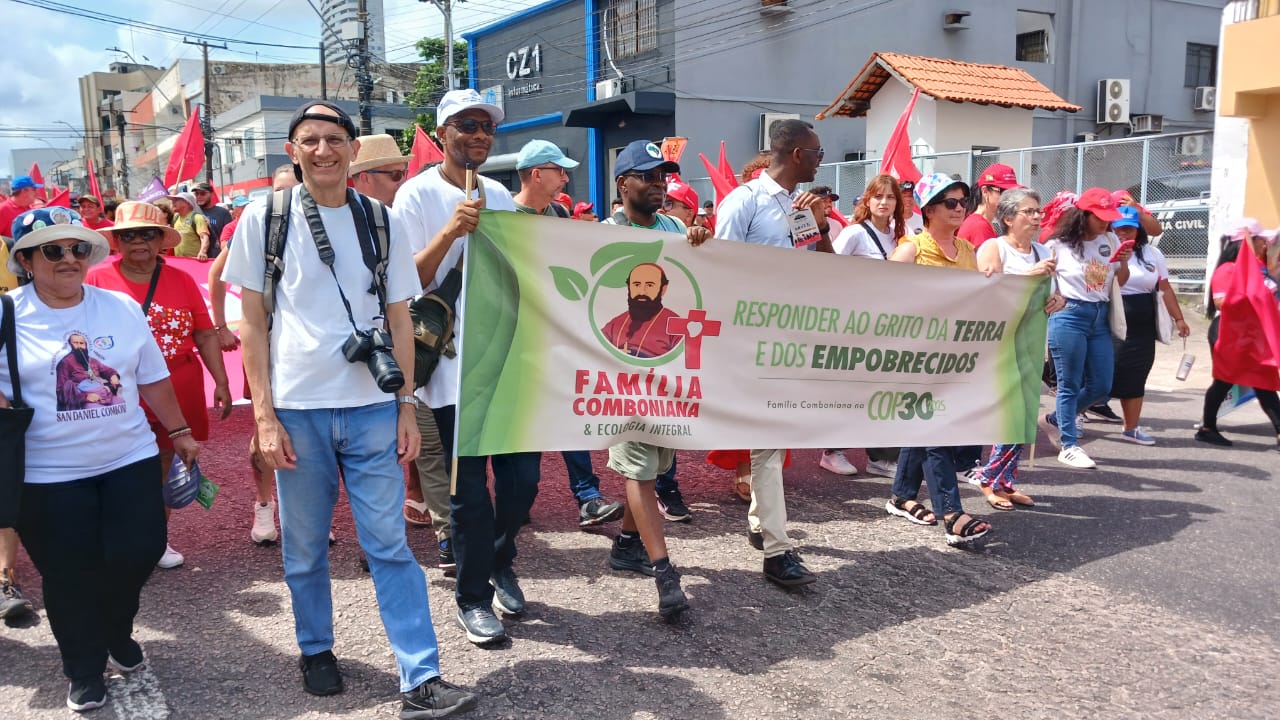
For the first time, the United Nations Climate Conference (COP) was held in the Amazon, one of the most important and threatened biomes in the world. The meeting of the waters all the way to the mouth of the Amazon River brought together peoples from around the world, with special emphasis on an increasingly aware and organized Indigenous protagonism. The Comboni Family gathered on this occasion highlighted: “Sharing the life and dreams of these peoples gave us hope: in Belém, we strongly felt the scent of mission!”
Seventy thousand people took part in the Global Climate March, demanding effective decisions, the abandonment of fossil fuels, the protection of territories, forests, and community life, and financing for the Global South. The People’s Summit brought together more than a thousand organizations and strengthened grassroots strategies and processes for environmental and social justice.
Even so, due to the power of corporate lobbying and the complicity of many governments, the results of the COP were once again far below what is required by the climate crisis. In this brief article, without being able to delve into the topics above, we want to share the reasons for the presence of the Comboni Family at the COP — a group of about 40 sisters, secular missionaries, lay women and men, brothers, and priests inspired by the charism of St. Daniel Comboni. We will do so through three verbs, which may also serve other groups or individuals.
Learning
It is increasingly evident that the cry of the poor is united with the cry of the Earth; there is no way to separate them anymore. This cry challenges our vocation as Christians and as lovers and defenders of full life for all: this is why, today, the mission of care is called Integral Ecology, as understood in the Church’s magisterium and in the encyclical Laudato Si’.
The Church was strongly present at COP30: during several days, 9 cardinals, more than 40 bishops from all five continents, and over 1,000 representatives from social ministries and Catholic communities took part. The Church came to the COP not only with proposals, but also with questions: “What can our contribution be? What can we offer from spirituality and the Gospel?”
Sharing with such diverse people and groups allows for a more complete reading of reality and also provokes conversion when we realize that our religion has, in several ways, separated creatures from the Creator, and the end times from the sacred time of daily care.
In the streets and debates, in workshops, chants, and prayerful moments in Belém, we strengthened interreligious paths, convinced that ethics, spiritualities, and cultures have the power to transform the world. We walked alongside social movements, renewing—through concrete engagement with their causes—what was recently celebrated during the Jubilee and the Meeting of Popular Movements: from Rome to Belém, celebration became commitment!
Building Alliances
In a time of severe crisis in multilateralism and democracy, with ever-growing challenges to peace and social justice in the world, we all feel small and powerless — at times even divided or isolated in self-referential actions. How important it is, then, to maintain strong alliances!
In Belém, we celebrated 25 years of Vivat International, which brings together 12 religious congregations — including Comboni men and women — to make political advocacy strategies more effective. We joined the Franciscan family celebrating the 800th anniversary of the Canticle of the Creatures, a revolutionary vision St. Francis left us as sacred heritage.
We reflected on and relaunched the Church of the Global South’s Document for Climate Justice and Care for Our Common Home, presented by the three cardinals who preside over the continental conferences of Asia, Africa, and Latin America & the Caribbean.
Finally, in various ways, we renewed our alliance with Indigenous peoples, defending their lives and cultures, convinced that the history of the climate will change beginning with the territories.
Planning
The Comboni Family’s commitment to Integral Ecology has been taking shape for several years in our reflection on mission. The 2022 Chapter of the Comboni Missionaries adopted Integral Ecology as a fundamental axis of mission, connecting pastoral, liturgical, formative, social, economic, political, and environmental dimensions.
Our gathering in Belém advanced along these lines, relaunching several proposals: strengthening Integral Ecology as a foundation for initial and ongoing formation; joining more decisively the main initiatives embraced by the Church; renewing the Comboni Pact for Our Common Home through spirituality and concrete commitments; consolidating Comboni political advocacy rooted in local territories; and strengthening the protagonism of communities, their dreams, and their cultures.
St. Paul, writing to the Romans, gave voice to all Creation and said that it “groans and suffers labor pains until now” and “waits with eager longing for the revealing of the children of God” (Rom 8:19, 22). The cry is so strong that we no longer have time to wait: it is time to reveal ourselves as sons and daughters of the Father, who created universal fraternity among all creatures.
Laudato Si’!