by Bro. Alberto Parise MCCJ
The Laudato Si’ Movement
Immediately after the publication of the encyclical Laudato Si’, the Global Catholic Climate Movement was founded in 2015, later renamed the Laudato Si’ Movement in 2021, with the aim of inspiring and mobilizing the Catholic community to care for our common home and to achieve climate and ecological justice.
The Movement consists of approximately 18,300 Laudato Si’ Animators and nearly 900 Member Organizations, present in 115 countries across all five continents, and organized into 30 chapters (territorial groups that bring together both types of members). Together, they work daily to bring Laudato si’ to life.
Concretely, the Movement has three strategic objectives:
- Ecological conversion: encouraging a change of heart (conversion) among Catholics and fostering a passionate concern for our common home, making care for creation a priority.
- Total sustainability: helping the Church and its faithful lead by example, embodying the motto “less is more” and reducing their carbon footprint to zero, in line with the urgency of the climate and ecological crisis.
- Prophetic advocacy: mobilizing the Church to raise its prophetic voice for climate and ecological justice, calling for bold policies to meet the Paris Agreement goal of limiting warming to no more than 1.5°C and to halt biodiversity collapse.
The theory of change underlying these objectives clearly follows a crescendo: starting from a profound shift in sensitivity, worldview, mindset, and ways of relating to creation and to all humanity—conditions necessary for adopting a sustainable and equitable lifestyle. However, systemic change requires more than initiating and consolidating good practices; it demands structural change and new policies.
This vision is pursued through Laudato Si’ Circles (LSCs), currently numbering 678 worldwide. These are grassroots groups that primarily offer educational and motivational support, spiritual formation initiatives, and the promotion of global awareness and mobilization campaigns, such as the Season of Creation (an ecumenical initiative held annually from September 1 to October 4), fossil fuel divestment campaigns, and the Fossil Fuel Non-Proliferation Treaty.
LSCs are small groups committed to ecological conversion and to deepening their relationship with God the Creator and with all members of creation. They meet regularly to pray, reflect, and act—the three “pillars” on which they are founded—with compassionate love and attentiveness to our common home.
Despite their diversity, all LSCs share core values: commitment to personal and ecological conversion (Laudato si’ 217); rootedness in contemplative prayer that integrates creation (LS 226); cultivation of relationships for a conversion that is also communal (LS 219); awareness of the interconnections between ecological and social issues within creation, in order “to hear both the cry of the earth and the cry of the poor” (LS 49); and a call for urgent and ambitious action (LS 13).
The Acceleration Driven by Pope Francis
Five years after the publication of Laudato si’, seeing not only a lack of conversion but also a continued increase in greenhouse gas emissions, Pope Francis sought to relaunch the encyclical’s message through a special anniversary year. This period was intended to renew its reading and initiate concrete paths of change, in light of scientific projections identifying 2030 as the likely end of the window of opportunity to reverse climate change.
At the conclusion of that year, the Laudato Si’ Action Platform was announced and officially launched on October 4, 2021. Rooted in the awareness that “interdependence obliges us to think of one world with a common plan” (LS 164, emphasis in the original), the platform invites the entire Catholic world to undertake a journey of ecological conversion and to overcome fragmentation by creating synergies for systemic transformation.
On October 4, 2022, the Holy See signed the Paris Agreement, assuming concrete responsibility for the ecological transition of Vatican City State. In 2023, in view of COP28 in Dubai, Pope Francis published the apostolic exhortation Laudate Deum, denouncing the inadequacy of the technocratic paradigm and the crisis of multilateralism, and calling for concrete and meaningful progress in climate governance. Only compromised health prevented him from attending COP28 in person.
In 2024, with the Bull of Indiction of the Jubilee 2025 (Spes non confundit), Pope Francis once again emphasized climate justice and the need for courageous actions of reparation. In short, we are witnessing a growing commitment from the Holy See in response to a rapidly deteriorating climate situation.
The Laudato Si’ Action Platform (LSAP)
The platform is a shared space through which the Church develops a decisive and active response to the ecological crisis. Promoted by the Dicastery for Promoting Integral Human Development, its primary goal is to encourage participants to develop an annual reflection and action plan tailored to the specific needs and charisms of each reality.
These plans are oriented toward achieving seven key objectives, known as the Seven Laudato Si’ Goals (LSGs):
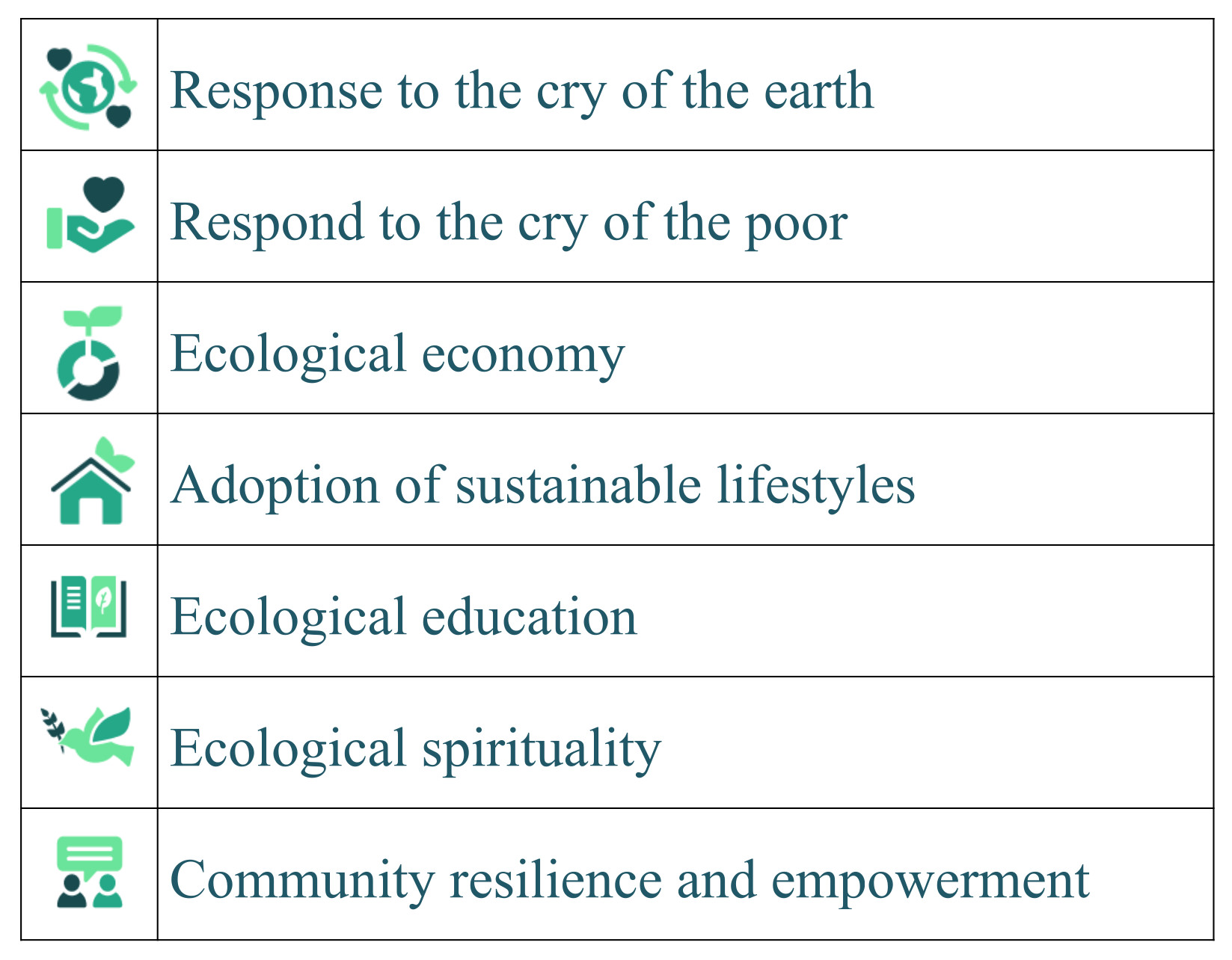
As shown in the LSG diagram, each goal is interconnected with the others. Everything is connected, and working on one goal inevitably influences the others. At the top are the two overarching goals: responding to the cry of the Earth and the cry of the poor. At the base lies community resilience and empowerment. The platform is conceived as a bottom-up process, characterized by the agency of the individuals and communities involved.
Through the platform, the Catholic Church seeks to promote concrete actions to address the ecological crisis, facilitating the sharing of resources, experiences, and best practices. It also offers a library of practical resources and webinars. Upon joining, participants select one of seven sectors to facilitate collaboration and exchange.
Three years after its launch, by the end of 2024, the platform recorded 10,060 registrations: 5,156 families and 4,904 institutions. Based on survey data, the platform’s direct impact is estimated at approximately 20 million people. Participation is global, though unevenly distributed across continents.
The Advocacy Dimension
As emphasized in the Laudato Si’ Movement’s theory of change, authentic ecological conversion must involve not only personal and communal change but also structural, systemic change. Experiences of integral ecology demonstrate that alternative economic models and sustainable, just, and fraternal ways of living are possible—but this is not enough. A true paradigm shift is required.
Systemic inertia and vested interests demand strong grassroots pressure to achieve such change. Catholic organizations therefore collaborate with broader civil society, popular movements, and Indigenous peoples, engaging in campaigns such as fossil fuel divestment, debt cancellation, and the Fossil Fuel Non-Proliferation Treaty. Pope Francis’ social magisterium (Laudato si’, Querida Amazonia, Laudate Deum) aligns closely with the perspectives of Indigenous peoples and environmental movements present at climate COPs.
Toward a New Economic Paradigm
Behind the platform’s promotion of sustainable lifestyles and ecological economics lies a broader alternative vision of the economy. While not explicitly formulated within the platform, this vision is nurtured by a rich ecclesial reflection.
One notable expression is The Economy of Francesco (EoF), launched in 2019 at the invitation of Pope Francis. Inspired by St. Francis of Assisi, it seeks a more just, sustainable, and inclusive economy grounded in simplicity, sharing, and care for the vulnerable. It brings together young economists, entrepreneurs, and changemakers under 35, combining theoretical reflection with concrete projects, research, startups, and collective action.
A particularly significant articulation comes from Brazil, where the movement has highlighted the feminine dimension, speaking of the Economy of Francisco and Clara, denouncing extractivist economics and financial violence, and advocating for an economy of buen vivir. This has led to the formulation of ten guiding principles for an alternative economy rooted in social justice, integral ecology, and solidarity.
Reflections for an Assessment
The paths described here highlight key synodal responses to the call for ecological conversion issued by Laudato si’. While the encyclical has borne much fruit, generating creativity and commitment, the scale of transformation remains disproportionate to the urgency of the crisis.
Social transformation unfolds slowly, while the planet may not have the luxury of time. The journey undertaken reflects the four principles outlined in Evangelii gaudium (217–237): time is greater than space; unity prevails over conflict; reality is more important than ideas; and the whole is greater than the part.
What is still lacking is widespread participation by Christian communities. Awareness alone is insufficient; what is needed is an affective, existential connection to the suffering of peoples and the Earth. As Pope Francis insists, closeness, compassion, and tenderness are essential. When we truly feel this connection, we recover our humanity—and change becomes inevitable.