In June of this year, Pope Leo affirmed: “You cannot believe in Jesus and wage war.” Here the pope seems to want to say that believing in Jesus means believing in his person, in his being, and in his nonviolent practice. Therefore, those who have faith in Jesus cannot wage war: for us Christians, the nonviolent choice is not merely a recommendable political option, but a choice of faith.
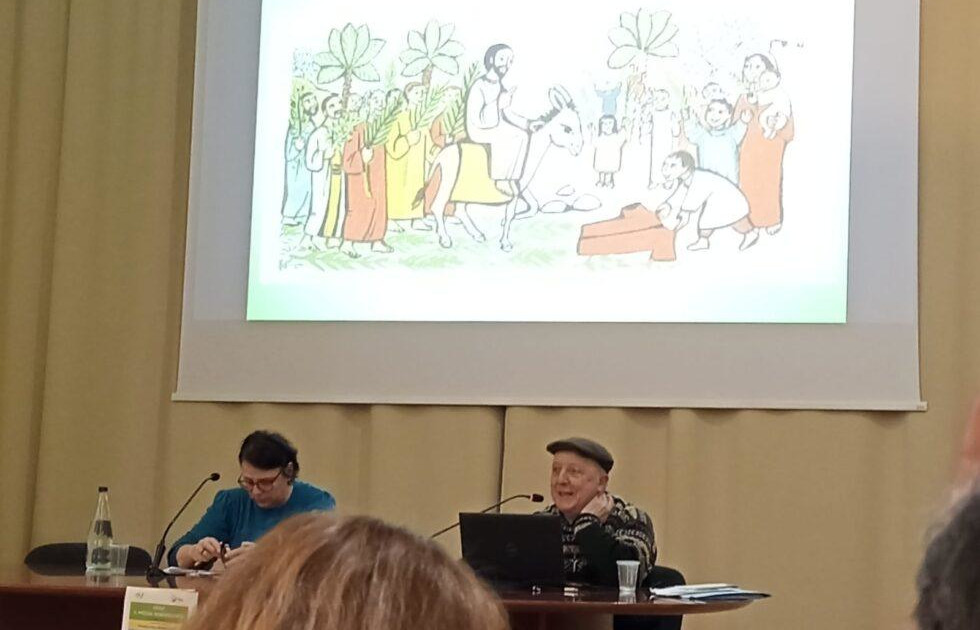
The prophet Zechariah gave us an image of the disarmed Messiah: “Rejoice greatly, daughter of Zion… Behold, your king comes to you: just and victorious, humble, riding on a donkey… He will make the chariots disappear from Ephraim and the horses from Jerusalem. The bow of war will be broken, and he will proclaim peace to the nations” (Zech 9:9).
Horses and chariots were instruments of war, and it is surprising to note that this Messiah brings peace by disarming not the enemy (Babylon or Egypt), but his own people (Ephraim and Jerusalem). By renouncing the warhorse and choosing a donkey, which was used for daily work, God announces that his Messiah will use only instruments of peace. Jerusalem will be able to rejoice in victory only after renouncing its horses and its weapons: the people will be able to know peace only if they disarm, renouncing the culture of violence in which they grew up. This is a message more relevant than ever. We are therefore called to destroy our chariots: only those who renounce all feelings of revenge and violence can be agents of peace.
The Gospels present Jesus’ entry into Jerusalem as the fulfillment of this prophecy: “Jesus found a young donkey and mounted it, as it is written: ‘Do not be afraid, daughter of Zion; behold, your king comes seated on a colt, the foal of a donkey'” (Jn 12:14-15). By identifying Jesus with the Messiah who comes to destroy all weapons, the Word tells us that the hour has come to put this disarmament into practice, the hour has come to work and struggle to build a nonviolent society in which there are no longer either oppressed or oppressors.
Peace in the Old and New Testaments
In the Bible, what defines the quality of our life is our relationship with God. Therefore violence indicates distance from the heart and intentions of God, while peace is communion with Him. Thus, understanding shalom as vital communion with God, the Old Testament identifies peace with the Covenant, with the saving intervention of Yahweh in our personal and communal life.
Developing the idea of shalom as a covenant between God and humanity, for the evangelists peace is the total and definitive communion of God with humanity that is realized in Jesus, the Emmanuel, “God with us.” Peace is a person, Christ: “He is our peace” (Eph 2:14). On this point, Leo XIV comments: “When we treat peace as a distant ideal, we end up not considering it scandalous that it can be denied and that war can even be waged to achieve peace… If peace is not a reality experienced and to be guarded and cultivated, aggression spreads in domestic and public life” (Message for the World Day of Peace ’26).
Disarmed Believers, Disciples of a Disarmed God
We know that many expected a warrior Messiah. The Qumran War Scroll speaks of a holy war in which angels are involved in armed struggle, and their goal is the total destruction of the enemies, the “sons of darkness.” It is obvious that Jesus’ messianism points to a completely different path: “Put your sword back in its place, for all who take up the sword will perish by the sword. Do you think I cannot pray to my Father, who would immediately give me more than twelve legions of angels?” (Mt 26:52-53).
In this passage, in which he renounces the sword, Jesus disarms his people and disarms God—that is, our idea of God. Pope Leo comments on this: “The Gospels do not hide that what disconcerted the disciples was his nonviolent response: a path that everyone, Peter first of all, contested, but on which the Master asked to be followed to the end… To those who would want to defend him, he repeats firmly: ‘Put your sword back in its place.’ The peace of the risen Jesus is disarmed, because disarmed was his struggle, within precise historical, political, and social circumstances. Christians must prophetically bear witness to this newness together.” It should be emphasized that, for Pope Leo, the fact that Jesus chose nonviolence is an established given, which is (or should be) part of our faith and our witness. The pope alludes to the precise historical circumstances in which Jesus made this choice—that is, the context of extreme imperial violence, in the face of which many pious Jews thought it was legitimate and dutiful to react with equal violence. Well, even in this context Jesus remained faithful to nonviolence, defying the mentality of his disciples.
Creating Alternative Spaces from Below
The great biblical scholar Norbert Lohfink emphasizes, regarding the solidarity-based and nonviolent lifestyle of the first Christian communities, that they did not attack the Roman Empire head-on but adopted a practice of life that, in fact, undermined the ideological and cultural system of the Empire at its foundations. For this reason Rome—generally tolerant of other religions—decided instead to persecute these small peaceful communities with unusual ferocity. “It is therefore useless to preach nonviolence to systems that by their nature are structured on violence,” states Lohfink. “The only hope of changing the situation is to establish new models of reality, through which God opens the way to create an alternative society.” We must create alternative spaces from below, nonviolent communities that set us on the path toward a more human kind of society. Are we up to this challenge?
Questions for personal and communal reflection:
- As Christians, are we aware that Jesus is nonviolent and chose the path of nonviolence?
- In what sense does this nonviolent God call into question the life and practice of our communities?
- Are our Christian communities today “alternative” communities? Or do we conform to the criteria of the “world”?
- In our parishes and our communities, do we educate for nonviolence and peace? How?