by Bro. Alberto Degan MCCJ
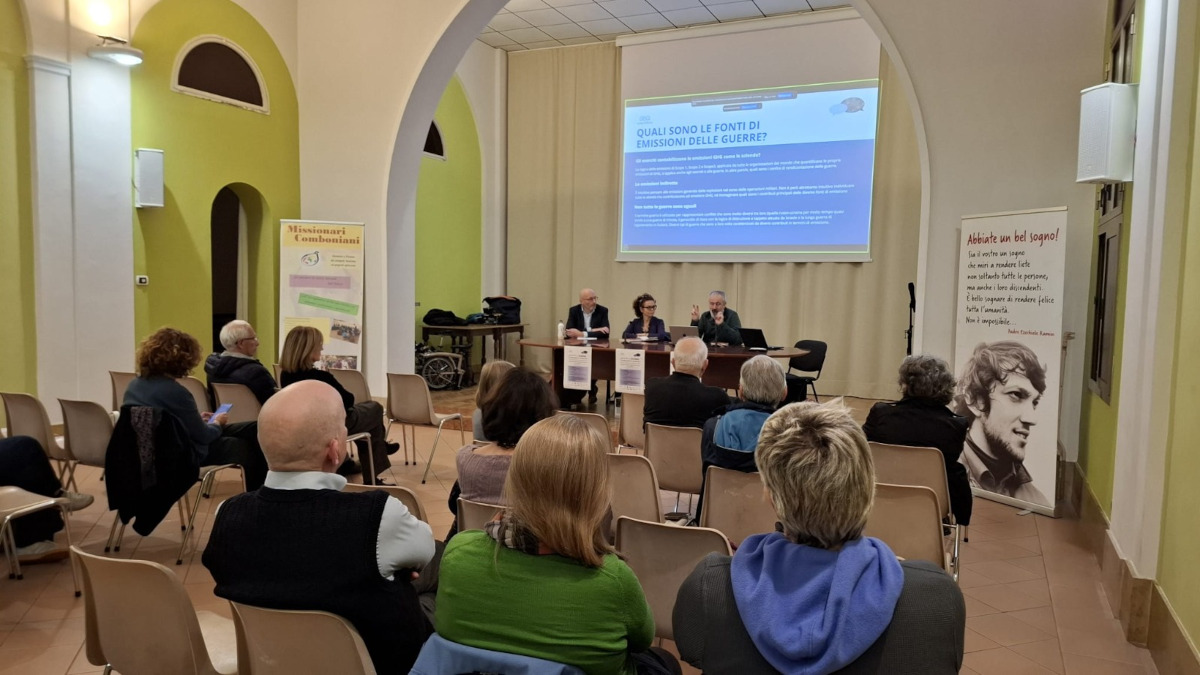
“Impacts of wars on climate change”: this is the title of a meeting organized by the Aequilibria Association at the house of the Comboni Missionaries in Padua. The speakers at this meeting were: Daniele Pernigotti, CEO of Aequilibria; Stefania Divertito, journalist and author of the book “War and Climate. The Ecocide That Destroys the Earth”; and Lennard de Klerk, independent researcher and expert in climate emission accounting.
At the beginning of the meeting, some premises were made on the topic. First, we must now become aware that it is not that the climate will change: the climate is already changing, it has already changed, and therefore we are talking about our present.
Secondly, someone might question the topic and ask: does it make sense to worry about the climate when there is a war? Should we not instead worry about human lives at risk? This is a legitimate objection, but we must not forget that there are not only today’s victims; there is also a temporal impact of war that will cause victims in the future, and nobody talks about this.
Another open question is that of the transparency and reliability of the data available to us: are the damages, and therefore also the environmental damages, of war accounted for reliably? Who collects this data?
Finally, we must remember that war is not only the emission of gases and the destruction of the environment, but also the destruction of any space for dialogue, trust, and collaboration, all of which are fundamental in addressing negotiations and possible agreements relating to climate change.
In the background, of course, remains the fundamental question: in the face of all this, what can we do?
A first thing to do is to become aware of the problem, and also to raise awareness in others. In this perspective, it is important to preserve the memory of the impacts. During the First World War, the battle of Verdun, near Paris, left thousands of shells that were absorbed by the soil and then by the aquifers. A zone was created where it is now impossible for human beings to live, because agriculture cannot be practiced. This forest of Verdun has been turned into a museum, which is visited every year by many students. It is important to preserve this memory and to realize that, in the long term, we all lose from war, both the “winners” and the vanquished. War leaves destruction that affects the lives of future generations. In this sense, we are colonizing time: we create damages that will be paid by those not yet born.
As for accounting, war emissions are accounted for, but not officially. At the first meeting on climate change, in Kyoto in 1997, an agreement was reached on the accounting of environmental damages, but armies were exempted from this obligation. Then, at the Paris meeting in 2015, rules on climate sustainability were established that all industries must comply with, all except the defense industry. For these industries, compliance with the rules is left to their free will, but in fact no military industry has ever submitted a compliance report.
On war emissions, therefore, official sources say nothing, but from other sources we know that, worldwide, the defense industry produces 5.5% of all “global” emissions.
Today there are sixty wars ongoing simultaneously, a historical record: it is difficult to quantify all the emissions produced by these wars.
Let us also remember that, in addition to human victims, wars cause many victims in the animal world. Some species become extinct also because of war, and this will have an impact on future generations. Article 9 of our Constitution, which has been amended, asks us to feel responsible also toward future generations, but we have not yet become aware of this.
At the legal level, becoming aware of all this implies recognizing as an offense and as a crime many actions that damage the environment. In this regard, the crime of ecocide has recently obtained some recognition at the level of International Law, but it is a recognition still subject to many restrictions and conditions.
After the speakers’ presentations, there were interventions from the audience, which relaunched the fundamental question: what can we do?
First of all, we must involve civil society. In this regard, a great example of involvement and resistance is the presence of “sentinels” on the ground. In Ukraine, for example, there is a platform on which everyone can upload photos or other evidence of environmental damage, and all this in a compensatory perspective, in view of a possible future compensation for the damages caused. More than 18,000 Ukrainians are registered on this platform. Many of them, while fleeing from a drone, photographed polluted rivers, or other things.
These sentinels are present everywhere, including in Gaza, where there is a museum of environmental damage, whose purpose is to keep alive the memory of how Gaza was before the genocidal war.
Someone then asked whether nuclear energy is less polluting than fossil combustion. The answer is that, certainly, at the emission level nuclear energy is better; then, however, it produces waste, which must be managed, and which is often reused to build weapons. This is the case of depleted uranium, which is a “waste” of nuclear energy, and with which very powerful weapons are produced. We must also remember that 80% of those who use nuclear energy also have nuclear weapons, so the use of nuclear energy is not the solution we are looking for.
Of course, there are many open questions, but the first step to take is to become aware also of this aspect of war, and of its lasting effects on the environment and on the lives of our children and grandchildren. Meetings like this contribute to an initial awareness-raising on this topic, which is so delicate and crucial for our present and our future.