
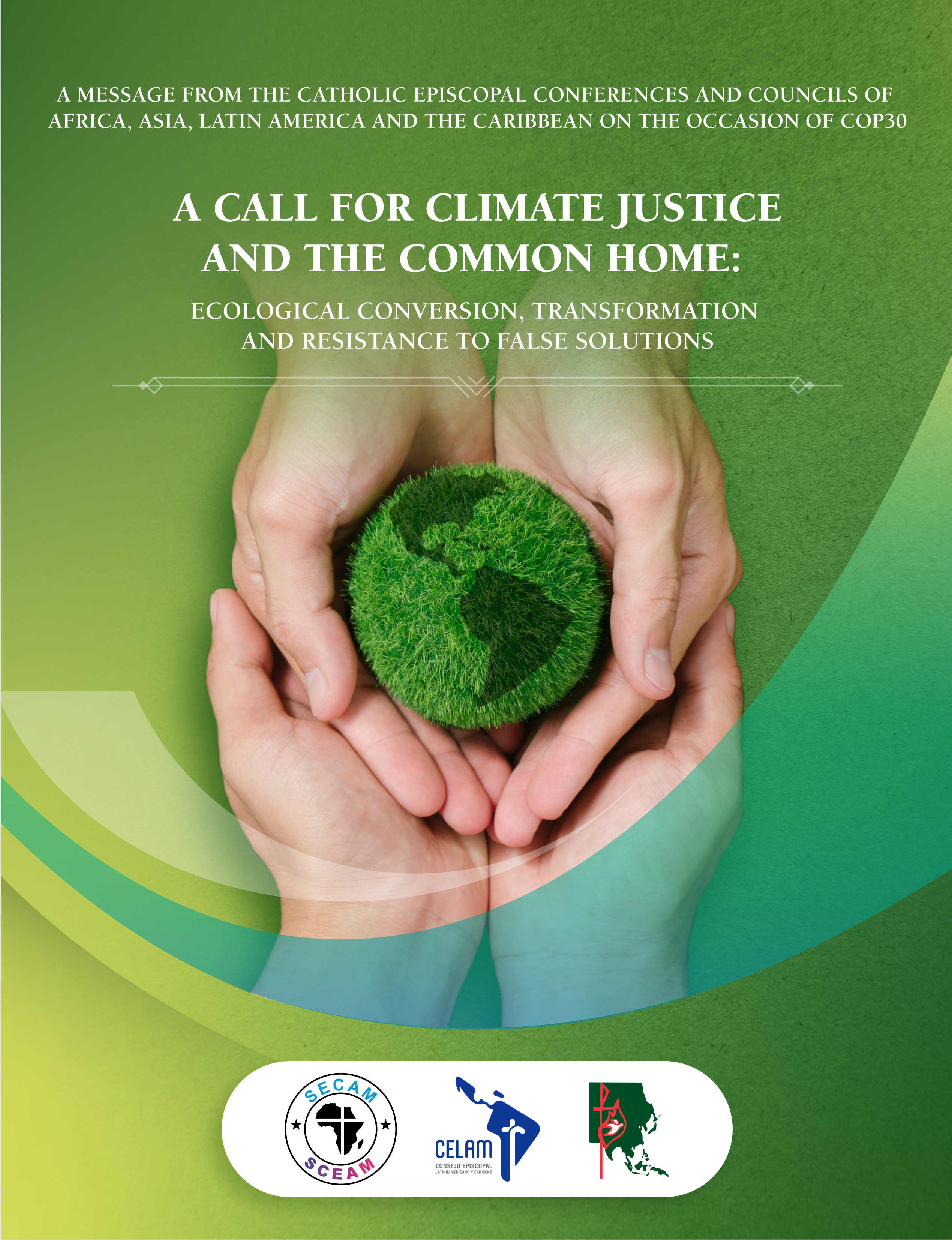
Ecological Conversion, Transformation, and Resistance to False Solutions
Getting to the Root of the Problem
It is no secret that multilateralism is currently in deep crisis. Yet, as the apostolic exhortation Laudate Deum reminds us, solid and lasting progress in addressing climate change requires the promotion of multilateral agreements among states (LD 34). The COPs remain a fundamental space for confronting and overcoming the crisis of our time. However, Laudate Deum continues:
“More than saving the old multilateralism, it appears that the current challenge is to reconfigure and recreate it, taking into account the new world situation. I invite you to recognize that “many groups and organizations within civil society help to compensate for the shortcomings of the international community, its lack of coordination in complex situations, and its lack of attention to fundamental human rights” (LD 37)
The collective initiative of Catholic bishops from the Global South demonstrates how seriously Southern churches have taken Pope Francis’ reflection and have embarked on a path that—especially in the Jubilee Year—takes on profound spiritual significance.
The document by the bishops of Africa, Asia, Latin America, and the Caribbean on climate justice represents a shared position of the Catholic Church in the Global South and openly and systematically addresses what might be called the “elephant in the room” at climate COPs: the capitalist development model—based on extractivism, unlimited growth, technocracy, and the commodification of nature—in its various forms (neoliberal, “green,” or, one might add, national-security oriented).
“Starting in the 2000s, the narrative of sustainable development began to be replaced by the idea of a “green economy,” promoted by some governments and multilateral agencies. The green economy, or the ‘greening of the system,’ as many authors call it, is a technical-instrumental logic at the service of the ecological restructuring of capitalism. What emerges in the political arena is an attempt to resolve the dilemma between economic growth and environmental care by proposing nature protection and environmental policy as sources of economic growth for a few. This involves creating a legal apparatus that helps to price, that is, to put a price on all of nature, which is then transformed into an asset that can be traded according to market rules among those who have access to it. However, this approach reveals limitations by reinforcing dependence on central economic paradigms, concentrating power in corporations and regulatory complexes, and deepening structural inequalities between developed economies and disadvantaged regions. Thus, the green economy emerges not as a break with capitalism, but as an incremental modernisation of capitalism, expanding its capacity for self-regulation while perpetuating systemic contradictions” (Message, 2025)
We are well aware of the deep tensions between the Global North and South at climate COPs. What is less discussed publicly, however, is that while these countries have conflicting interests, they nonetheless operate within the same development logic. They are competing, but largely on the same side. Only a few countries—and especially civil society observers and Indigenous peoples—question this development model and call for its transcendence as a condition for effective climate action (for example, Small Island Developing States, Bangladesh under Muhammad Yunus, or Colombia under Gustavo Petro). The Church now articulates this vision in a systematic way.
The bishops begin with reflections on climate justice and climate debt—issues already widely addressed in Pope Francis’ social magisterium:
“Countries in the Global South, which have contributed the least to the problem, face the worst consequences. The $300 billion per year promised continues to fall short of the funds needed for adaptation, mitigation, and loss and damage.
It is estimated that the climate debt of the wealthy Global North, which includes countries in North America and Western Europe, will reach $192 trillion by 2050, based on its significant share of historical and current carbon emissions and the economic benefits obtained at the expense of the Global South. In addition, it is estimated that approximately $2 trillion is extracted from the Global South each year through corporate, banking and government mechanisms.
To repay this climate debt, the Global North must take decisive action: halt environmental damage, invest in initiatives to mitigate and adapt to climate change, and compensate for damage that cannot be reversed. At stake is ensuring equity in addressing the impacts of climate change, especially for vulnerable communities in the Global South.” (Message, 2025)
Beyond the Deception of False Solutions
The energy transition cannot be separated from the transition to a different development model and must be compatible with nature-based solutions to the climate crisis.
“Ecosystems are not “environmental services” for sale, but rather a complex set of multiple interactions between living and non-living beings, human and non human, part of God’s Creation, that must be cared for and respected. We therefore demand that nature-based solutions be freed from market logic, emphasising their objective of mitigating climate change, regenerating biodiversity and sustaining people’s livelihoods. We therefore reject, for example, financialisation initiatives such as carbon credits based on REDD+ or voluntary carbon markets, etc.” (Message, 2025)
The bishops also condemn the negative impacts associated with the technocratic paradigm, such as pressure on water resources and electricity generation for data centers, as well as increased mining for electric vehicle production, among many other socio-economic impacts. The idea of a “just energy transition,” they note, often perpetuates the current development model, benefiting large multinational corporations from the Global North while imposing disproportionate costs on the Global South.
This critique of false solutions echoes Pope Francis’ magisterium, which challenges the technocratic approach that claims technology and market mechanisms can solve any problem without questioning the system that causes it.
This approach operates by playing on illusions and fears: on the one hand, the promise of brilliant technological solutions generating economic growth; on the other, the threat that if the system collapses, people’s livelihoods will disappear. No one seems willing to embrace the kind of transformation that would require extraordinary measures—such as those seen during the COVID-19 pandemic or the 2007–2008 financial crisis—which demonstrated that political will can mobilize resources, but also revealed a tendency to contain effects rather than pursue systemic transformation (cf. Laudate Deum 36).
Toward a Different Economic Model
The bishops call for a transformation of the economic system, proposing a model compatible with planetary boundaries and degrowth objectives. They envision reduced demand and consumption, and the promotion of circular, regenerative, and solidarity-based economies. They call for production and consumption policies that transform production cycles and consumer culture, while ensuring that economic and energy transitions do not perpetuate inequalities or undermine human and environmental rights.
Such discourse remains largely taboo in COP negotiations. Civil society and Indigenous voices denouncing the impacts of the dominant economic model have yet to break through negotiating tables. The unified stance of Catholic bishops from the Global South is therefore a significant step, particularly as a commitment to fostering new awareness and embodied spirituality. How this vision will be integrated into pastoral programs and faith journeys remains to be seen.
We appear to be living through the darkest hour: conflicts seem uncontainable, arms races have reached unprecedented levels, and resources are diverted from social services and climate action. Multilateral diplomacy has weakened, replaced by the law of force rather than the force of law (Fratelli tutti, §174). Human and peoples’ rights are ignored, inequalities deepen, and the planet is pushed beyond its regenerative capacity—yet widespread determination for a new economic-financial model has yet to emerge. This is why faith communities are called to believe in the real possibility of transformation and to keep hope alive—a central theme of the Jubilee Year.
Ecological Conversion and Joyful Sobriety
At the heart of a different economic model, the bishops argue, lies ecological conversion and a vision of life oriented toward joyful sobriety. Drawing on Laudato si’, they recall that sobriety is “more than a lifestyle: it is a necessary ethical and spiritual response to the climate crisis, aimed at a future where the common good prevails.”
“Sobriety, when lived freely and consciously, is liberating. It is not a lesser life or one lived with less intensity. On the contrary, it is a way of living life to the full […] Happiness means knowing how to limit some needs which only diminish us, and being open to the many different possibilities which life can offer.(LS 223)” (Message, 2025)
Echoing Laudato si’ §223, the bishops note that this vision aligns with the Indigenous concept of buen vivir.
“Pope Francis proposed a system whose economy is at the service of life, not profit; that includes the poor and is based on solidarity, not competition; that cares for creation, is at the service of peace in the world, rejects armament and is committed to reducing inequalities.” (Message, 2025)
The Church commits to five actions to promote this transformation: joyful sobriety as resistance to consumerism; education for ecological conversion; strengthening local communities; ongoing dialogue with science and Indigenous peoples; and promoting narratives of hope, care, art, and spirituality.
Expectations for COP30
COP30 will focus on renewing national commitments to reduce greenhouse gas emissions (NDCs), ensuring broad participation of local communities—especially those most affected. In the spirit of climate justice, bishops call on wealthy nations to provide adequate financing for developing countries and to build a North–South coalition for climate, nature, and humanity.
Conclusion
The bishops reaffirm that certain principles cannot be sacrificed in the name of climate commitments that perpetuate injustice. At the center lies the need to abandon an economic model based on infinite growth in a finite world and to adopt a regenerative, distributive economy focused on care for life and the common home. This requires degrowth, fossil fuel phase-down, renewable energy transitions, debt cancellation, and climate policies centered on human dignity and the rights of nature.
Bro. Alberto Parise MCCJ

