To believe and commit ourselves so that another history may be possible.
by Bro. Alberto Degan mccj
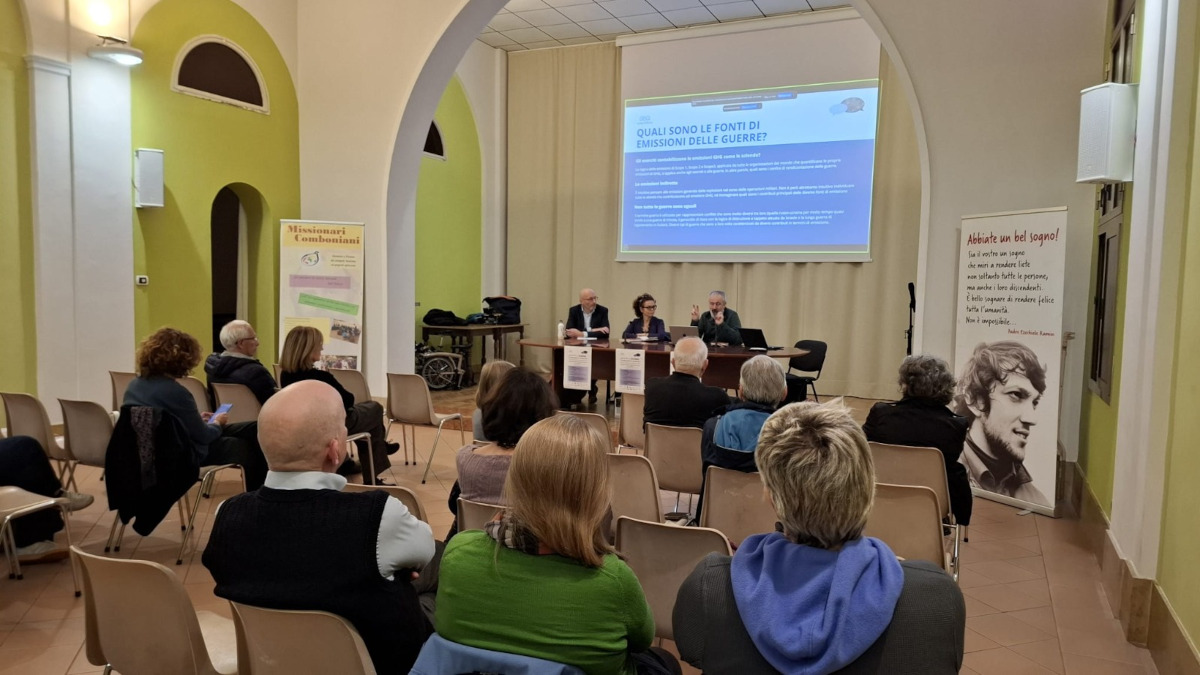
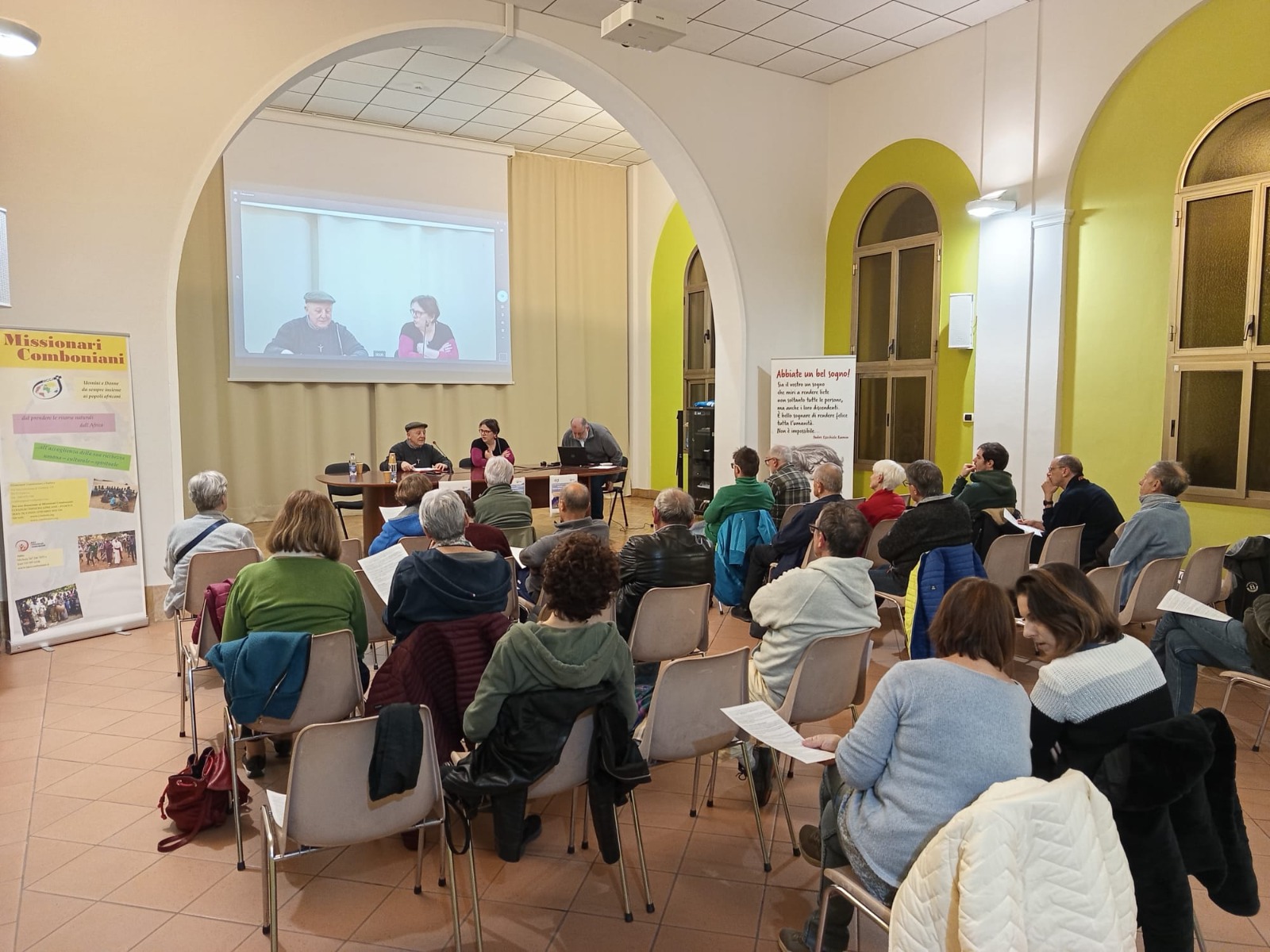
On Thursday, November 29, a cycle of six meetings began, coordinated by the Comboni Missionaries and by the Comboni Lay Missionaries of Padua, on the theme: “If you want peace, prepare peace. For a spirituality and a practice of nonviolence.” This journey, more than to give answers, is designed to keep the questions alive in us, in a world that wants to convince us that we must resign ourselves to injustice and war as the normality of our life. As Leo XIV says, on the one hand we recognize the expansion of a culture of power characterized by polarization and violence; on the other hand, “despite this downward spiral, we can also glimpse a great part of humanity that is striving to remain human and working to build the holy city of coexistence and peace.” (MH 185). To remain human in this context, in which all the wise men of the world cry out ‘war’ to us, we need a strong spirituality that sustains our counter-current commitment.
The first meeting was entitled: “Peace exists and wants to dwell in us. To believe and commit ourselves so that another history may be possible.”
The death of peace?
Last year a death sentence was issued against peace: “The peace of yesterday is over. We have no time to indulge in nostalgia,” said Ursula von der Leyen, because we now live in “a world of wars, a world of predators.”1 We must therefore surrender to reality, stop chasing a nostalgic dream, peace, and prepare to respond to the violence of predators with equal – or greater – violence.
Besides, it is not the first time that the political reasonableness of the commitment to peace has been called into question. In 1993 a famous Italian political scientist, Ernesto Galli della Loggia, defined Article 11 of the Constitution, which repudiates war as an instrument for resolving international disputes, as bizarre and pathetic. Because war, said the political scientist, has always been the conceptual focal point of history, and therefore it is bizarre and absurd to repudiate it. Well, as Christians we claim the right to be bizarre. If being wise means believing that inhumanity is our only horizon of life, better to be bizarre and continue to believe in the announcement of the Risen One: “Peace be with you!”
Believing in the light
Obviously we all see the darkness, but as Christians we also see the light that shines in the darkness: “The light shines in the darkness, and the darkness has not overcome it” (Jn 1:5). The Pope too, in his message for the World Day of Peace 2026, underlines this: “The contrast between darkness and light… that unsettles us and affects us amid the trials we face in our historical circumstances. In order to overcome the darkness, it is necessary to see the light and believe in it. (…) Peace exists; it wants to dwell within us. It has the gentle power to enlighten and expand our understanding; it resists and overcomes violence.” Saint Paul says that “Jesus is our peace” (Eph 2:14). For us Christians peace is a person: Jesus. Jesus is alive: he died but he rose again. Peace, therefore, exists, is alive and asks us to welcome it, and when it enters into us it enlarges our intelligence, that is, it makes us see possibilities and paths to follow that the limited intelligence of the warmongering mainstream cannot glimpse. Where the mainstream sees only darkness and the irremediability of war, the light also sees the possibility of dialogue and cooperation.
The mainstream offers us a diabolical narrative: peace, dialogue, brotherhood now have no possibility of operating in history, and it is pathetic to continue believing it; the only forces that count are violence and selfish appetites. In other words, they want to make us believe that it is no longer possible to remain human and to live humanly in History. God, on the other hand, continues to believe that his children, made in His image, can give life to a human history, of peace.
We are therefore called to cultivate a spirituality of nonviolence, in which believers of other religions can also recognize themselves, like Gandhi, who believed in satyagraha: he believed that in the conscience of every man there is the force of truth, the force of beauty: it is not true that man is only violence and bullying; man has engraved in his DNA the conscience of good and evil, the force of love that calls him to respect the life of every living being.
In short, to use the words of the Pope, we are called to believe in the Light, to believe in God’s ‘Magnificent Humanity’ project, incarnated in Jesus, to believe that God has placed the seed of this light in the DNA of all his children. Believing in this light is the center of our faith: if we let ourselves be convinced by the mainstream message, according to which peace is dead and in the heart of man there is only violence and a predatory spirit, we are betraying the heart of our faith. Let us ask ourselves: is living and being human as God conceived us only a nostalgic and bizarre illusion? If we believe this, we are condemned to inhumanity. Peace will be possible only if we believe in the beauty and the light engraved in the DNA of our humanity.
As the Pope says, “grace does not magically eliminate conflict, but instead it inspires active resistance to evil and an astonishing creativity in doing good. Christians see the darkness… yet they do not merely gaze upon it passively, for they know the light and understand that the darkness has not overcome it and cannot defeat it.” (MH 211). Resisting evil and being creative in good is part of the beauty of our humanity. Thanks to this creativity the human being – in a world dominated by winds of war – has the ability to write a counter-history of fraternity, justice and peace.
Proposing another narrative
In the face of the warmongering culture, as Christians we are called to propose another narrative. First of all, we must restore political legitimacy to certain words and values that the mainstream considers ‘bizarre’ and ‘pathetic.’ In the Message for the World Day of Care for Creation this year, Leo IV says: “The true instruments for building peace are not weapons of destruction, but rather truth, dialogue, patience, goodness, justice, mercy, understanding, care and love…” Undoubtedly someone will smile at the thought that love, patience and mercy are considered instruments and attitudes of political action. For the mainstream, certainly, this is a pathetic absurdity, but the problem is that by dint of hearing it said to us we too are convinced that it is ridiculous to associate politics with love. We must believe that the Light has a role in political life too.
Secondly, we must denounce, as the Pope does, that behind these winds of war there are enormous concentrations of private economic interests. In this regard, let us remember that the European Union has decided to increase military spending a hundredfold (!) within 5 years.
This policy of rearmament is not a response to an objective necessity, but is the fruit of a deliberate decision by political and economic elites, who within a few years have completely changed the public discourse on peace and war. The Pope is very illuminating on this point, when he says that in public discourse, it was commonly believed that war should remain an extrema ratio, surrounded by rigorous ethical and legal limits, and in any case by a political horizon oriented toward peace. Peace had been placed at the center of the international order, as attested in particular by the Charter of the United Nations, which aims to save future generations from the scourge of war. Today, instead, we are witnessing a true paradigm shift in public discourse and in rearmament choices, with a worrying rehabilitation of war as an instrument of international politics. It is in this climate that humanity is sliding into the violent culture of power, where peace no longer appears as a task to be undertaken, but as a precarious interval between conflicts (MH 189-192).
Until a few years ago, peace – even amid many contradictions – was seen as the goal of international politics, as a task to be carried forward even amid many difficulties. Today, instead, peace is no longer seen as a commitment to be undertaken, not even in the long term, but as an illusion, a nostalgic chimera, which does not fall within the realm of real possibilities.
In this perspective, world Public Opinion has a fundamental political role: it is up to us, as a conscious civil society, to accept the mainstream narrative or to believe in the Light and announce another narrative. Let us not believe those who say that a history based on bullying is the only possible history! Pope Leo launches this challenge to us: “We must ensure that this season of history marked by war and the arrogance of force sets soon and a new history begins. A different history of the world is needed: ‘the history of the negotiating age,’ the history of a new world without war,” based on “dialogue, negotiation and cooperation.”2
The voids of history
To write a different history, it is fundamental to be aware of the voids of history, as Ugo Vanni called them. We are called to “irradiate and fill with the values of Christ the great voids of history,”3 that is, all the areas of human life in which we have not yet allowed Jesus to enter. It is surprising to see how, after two thousand years of Christianity, there remain still very great spaces of our life empty of Christ: an economy that looks only to the interests of a small minority and does not care about the life of the majority of humanity; a foreign policy inspired by the logic of profit and violence, etc. In fact, it seems that it does not cross any politician’s mind that international relations too should follow the logic of love and fraternity. But if these voids exist, it is first of all our fault, who are resigned to the fact that in these spaces the love of Jesus cannot enter. Now, however, we are called to overcome our resignation, and to struggle to fill these voids with the love of Jesus. We must transform our economy and our politics! As believers in the Light we are called to embrace in all its fullness the Gospel of justice and peace.
At the end of the meeting we left some questions for personal and community reflection:
a) In our life, have we experienced the Beauty of God’s ‘Project Humanity’? How?
b) Today, among believers, does hope and faith in the ‘Project Beauty’ inscribed in our DNA prevail, or resignation to living in a subhuman world?
c) Are we ‘conscious citizens’? Or do we passively accept the history written by the powerful?
d) Have we experienced the ‘surprising creativity of good’ of which Pope Leo speaks?
Notes
1. https://www.ilfattoquotidiano.it/2025/12/17/von-der-leyen-guerra-ibrida-europa-notizie/8230609/
2. Discorso del 28-10-2025, https://press.vatican.va/content/salastampa/it/bollettino/pubblico/2025/10/28/0807/01437.html
3. Ugo Vanni, L’ebbrezza nello spirito. Una proposta di spiritualità paolina, AdP, p. 56.